Water Extraction in Cranston, RI
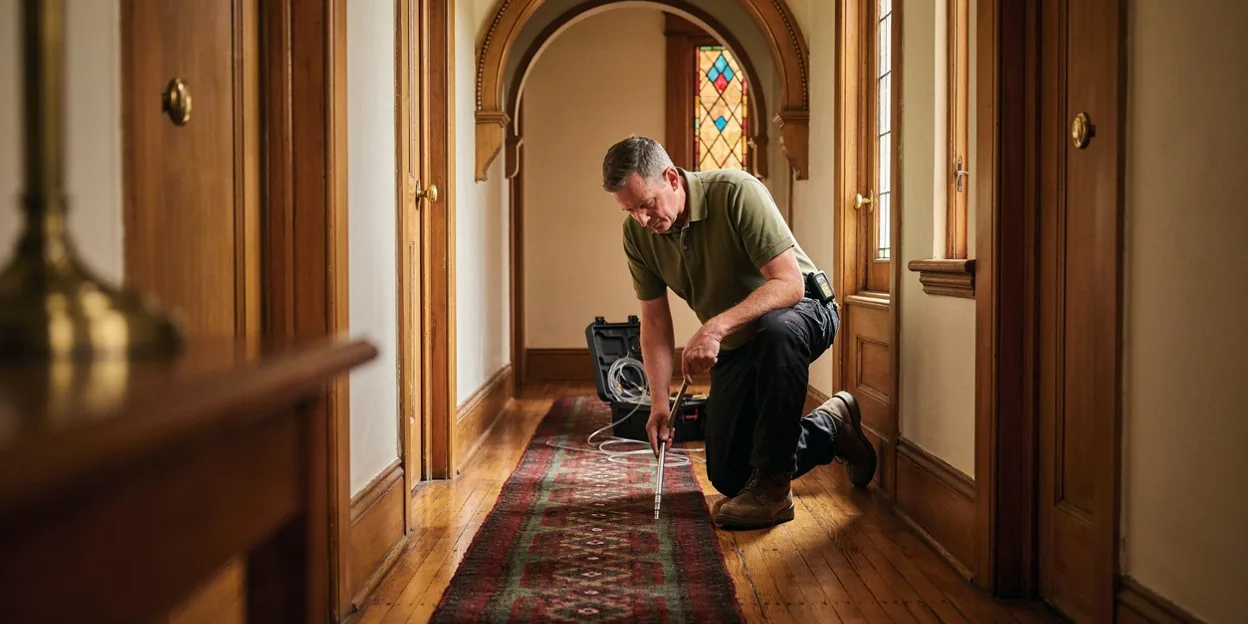
You went down to the basement for the laundry and stepped into an inch of water. The washer hose let go sometime overnight, the drain could not keep up, and the water has spread under the workbench, into the boxes along the wall, and around the base of the furnace. We connect you by phone with an independent local provider who pumps out standing water in Cranston, Providence, and the towns around them.
What the crew does first
The crew makes sure the source is off, then pumps and vacuums the standing water off the floor. On a concrete basement slab that goes fast. On a finished floor upstairs it means weighted extraction across the carpet and pad, or squeegee work on tile and wood, until the surface stops giving up water.
Then they meter. Every room the water touched gets a reading, and so do the rooms next to it, because water crosses a doorway or drops through a floor faster than most people expect. The point of the first visit is a map of what is wet, so the drying that follows goes where it is needed and nowhere else.
What to do in the next hour
Shut off the water at the main valve, which in most Cranston and Providence houses is on the basement wall near the meter. If the water is near the electrical panel or an outlet, turn off that breaker from a dry spot or leave it alone and stay out of that area. Do not run a household vacuum on standing water.
Carry what you can upstairs. Pull rugs off wood floors and open cabinet doors under sinks. Take photos of every room and the water line on the wall before anything gets moved or thrown out. Then call us. You do not need to know how much water there is; tell us which rooms and whether it is still coming in.
What is usually saved and what is not
Concrete, framing, and subfloor usually dry in place when the crew reaches them within a day or two. Tile floors survive. Hardwood and old pine can often be dried with mats if the water was clean and did not sit long. Carpet in a basement usually comes up so the pad underneath can go, and the carpet itself may go back down or may not, depending on the water.
Cardboard boxes, particleboard shelving, and the bottom foot of drywall or paneling on a wet wall almost always come out. Once the bulk water is gone, structural drying is the rest of the job, and in a below-grade room it is most of the job.
Providence County notes: where the water collects
Most of the houses between Edgewood and Garden City were built from the 1920s through the 1950s on stone or block foundations, and the basement is where the water ends up whether it came from a hose, a heater, or the ground. Triple-deckers in Providence send a second-floor loss down through the first-floor ceiling and into the cellar. Split-levels in western Cranston have a lower level half below grade that catches everything.
Groundwater is its own source. After the March 2010 storms, when the Pawtuxet River crested at 20.79 feet at the Cranston gauge, basements across the river neighborhoods filled from the floor up, and that kind of water is a basement flooding cleanup job with a contaminated-water twist. A floor drain that pushed water back up during a heavy rain is a sewage cleanup job, not an extraction job, and the crew treats it that way.
Many policies cover a sudden loss like a failed hose or a split pipe. Seepage and river water are usually a different story. Ask the crew to record the water line, the first readings, and the photos so the timeline is on paper for your adjuster.
Calling about water extraction
Tell us which rooms have standing water, whether it is still coming in, and where you think it started. Say if it is a basement, whether the water smells or came up through a drain, and whether the power is on. Call (401) 443-9638 now and tell us what you see.